 Privopact
Global Privacy Control, on every site.
Automatically ask websites not to sell or share your personal data, and see which ones listen. Install it once and it quietly works in the background.
- Chrome, Edge & Brave
- Two permissions
- No data leaves your device
- Open source (MIT)

A "do not sell" request sites have to respect.
Global Privacy Control is a signal your browser sends with every request, telling websites you don't want your personal information sold or shared.
Unlike the old Do Not Track signal, GPC has legal weight. In California, Colorado and a growing list of other states, businesses must treat it as a valid opt-out request. Most browsers just don't send it. This extension does.
GET / HTTP/2
Host: news.example.com
Sec-GPC: 1

navigator.globalPrivacyControl
→ true
Set it once. Protected everywhere.
-
Install the extension
Add it to Chrome and GPC switches on straight away. There's nothing to set up and no account to create.
-
Every site gets your signal
Each request carries the
Sec-GPC: 1header, and pages seenavigator.globalPrivacyControlset to true. -
See who's listening
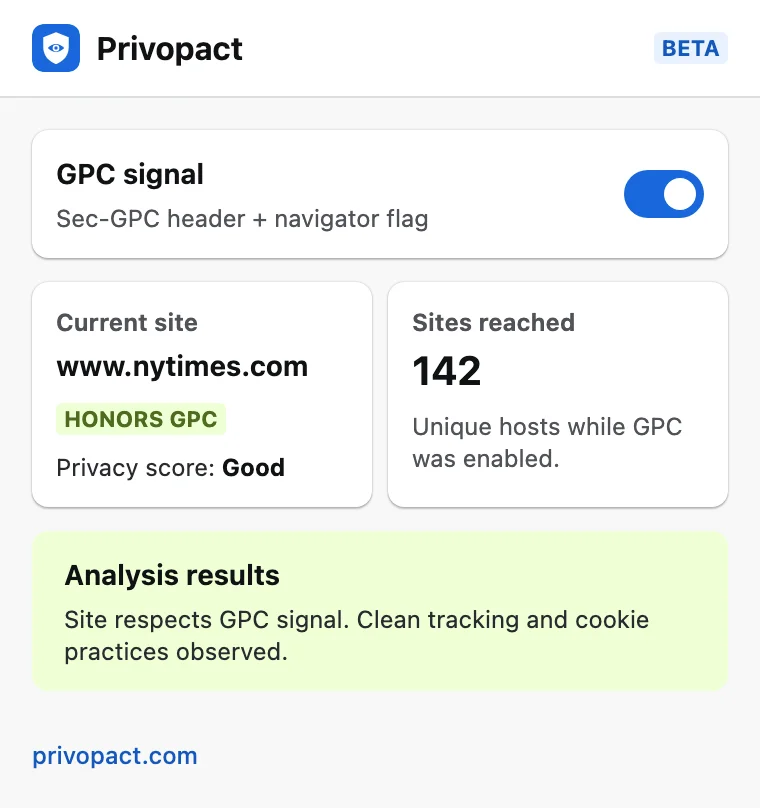
Open the popup to see whether the current site says it honors GPC, along with a simple privacy score.
Small, quiet and private.
The extension asks for only the permissions it needs and keeps everything on your device.
- Sends GPC through both the request header and the JavaScript property
- Checks each site's
/.well-known/gpc.jsonfile to see if it says it supports GPC - Scores each site on trackers, cookies and whether it has a privacy policy
- Turn it off and on at any time with a single switch
- No account, no ads and no data sent to Privopact servers
- Open source under the MIT license. Read the code on GitHub
Good questions.
Is it really free?
Yes. The extension is free with no paid tier, no ads and no account.
Does the extension collect my browsing data?
No. It looks at the sites you visit only to show you results in the popup, and keeps a short history on your device. Nothing is sent to Privopact. Read the full privacy policy.
Is the code public?
Yes. The extension is open source under the MIT license. You can read the code on GitHub, check exactly what it does and build it yourself.
Will every website honor the signal?
Not every site does yet. Businesses covered by laws such as California's CCPA must treat GPC as an opt-out request, but many others ignore it. The popup shows you which sites say they honor it.
Will it slow down my browsing?
No. Chrome itself adds the header, and the site check runs after the page has loaded.
Does it block ads or trackers?
No. It sends a legal opt-out request rather than blocking content, so it works alongside the ad or tracker blocker you already use.